Monday, February 17, 2014

Plants vs. Zombies Review (PS3)

     I guess Plants vs. Zombies is mainly a phone/tablet game... I'm kind of out of touch with those devices. But when I played the demo of the PS3 version, I was sold.
     Plants vs. Zombies is a tower defense game that has you defending your house from brain-starved zombie hordes with an unlikely ally; sentient plant life. The graphics are cute and cartoony and consist of brilliant HD sprites. If you're a fan of HD sprites, you won't be disappointed as this game is packed full of great ones. There are 49 plants in the game, and each one is a silly, happy (or angry) little guy with great attack and idle animations. These range from pea pods that shoot out peas like a cannon and watermelon plants that launch like a catapult to sunflowers that produce extra sunlight (which you spend to plant more seeds) and walnuts that block the zombies' path. Each plant has a little text blurb to accompany it in the game's almanac, and these are generally clever and cute as well. With almost all of the plants, there is a great sense of visual design. If you're a fan of urban vinyl toys, you'll like what's in here; the plants have a very Yummy vibe to them. Ditto for the 26 zombie types and the great looking environments.
     There are many game modes, so I'll start with the campaign and work my way out from there. The campaign presents 5 overarching levels that consist of 10 stages each. At the beginning of each stage, you are shown what types of zombies you will be facing and then you choose what plants you are going to take with you into the level. Typically you will be facing certain specialized zombies and will need to take certain plants that can counteract them. For example, if you are facing zombies that use makeshift shields, you would take mushrooms that shoot out armor-piercing gas. If you are facing zombies on Zambonies, you would take thorns that pop their tires. If you are facing zombies that jump, you might take big walnuts to block their jumps. When the level starts, you have a few seconds of peace before the zombies start marching toward your house, which is on the left side of the screen. Zombies start all the way on the right side of the screen and march toward the house in one of 6 horizontal lanes. If a zombie reaches the house, a lawnmower will run over and instantly kill all of the zombies in that lane. This is a one-time occurrence. Once a lane's lawnmower is gone and another zombie reaches the house, they go inside and kill you, and it's game over.          Each lane has 9 spots to plant your defenses. Each plant costs a certain amount of sunlight. You collect sunlight as it drops out of the sky from time to time by running your cursor (controlled by the left stick) over it. You can also set down plants that generate sunlight for you (this is a requirement to beat almost any level).
The plants you have chosen for a level are displayed at the top of the screen. You use R1 and L1 to select which plant you want, and then use the analog stick to move the cursor to where you want to plant it and press x to plant. Holding down circle digs up a plant if you want to remove it from a spot to plant something else. Once you plant...a plant, it has a cooldown time before you can plant it again. Some plants recharge quickly and can be rapidly planted all over while others take a long time to recharge. Whenever a plant is in range of a zombie, it will attack it automatically. Most plants only attack zombies that are in the same row as them, although there are some exceptions. A progress bar at the bottom of the screen shows you how far into the level you are and when big groups of zombies are coming up. If you survive until the end of the progress bar, you clear the stage. Most levels last 5-10 minutes. That's basically it, but from this simple idea comes a huge amount of variety.
     Almost every level you beat earns you something new. Often it's a new plant or a new zombie type that will attack you in the next level. Each overarching world in the game offers a twist on the pattern as well. The backyard has a pool that gets attacked by aquatic zombies and requires aquatic plants to defend it. Night time levels don't produce sunlight but give you access to cheaper mushrooms that behave differently than day time plants. Fog levels obscure your vision of big chunks of the yard, and rooftop levels require you to place pots for your plants and make you use indirect firing plants due to the slant of the roof.
     Every fifth level in the campaign is a special level that plays differently. Usually it involves playing without sunlight using plants you can plant for free but are only provided to you one at a time, forcing you to work with what you are given. There are a few other variations too. These levels are very fun and work well to break up the other levels. Playing a few normal levels in a row can feel a bit samey, so having something different to break up the pacing is a great idea. One of these levels is a brilliant thunderstorm level that is really atmospheric and fun.
     The campaign is a bit on the easy side, with a few challenging bits here or there, and is a bit long for being so easy, but it is also pretty engaging and fun. The way the game gives you new plants, enemies, and scenarios is really well paced, but I don't recommend playing the campaign for hours on end as it can get a little boring since most levels play out very similarly (albeit with new plants and enemies and stuff). Once you find how you like to build your defenses, you end up doing that every level, with some experimentation and changing as you gain new plants. Still, you usually end up building similar defenses every level with changes here and there.
     So, let's talk about the other modes. Once beaten, you can play the campaign over again. The second time through there are more big waves of zombies and three plants are chosen automatically for you, limiting your choices a bit and making you use certain plants. There are vs. and co-op modes, which I didn't try. There is puzzle mode, which has 18 levels of 2 different flavors. In one, you play as the zombies and try to defeat the plants, and in the other, the level is filled with vases you crack open to reveal either a zombie or a plant. These vasebreaker levels are very fun. Mini-game mode has 20 levels that have interesting rules, like super-fast zombies, zombies with plant heads that attack you, and a fun mode that put's you up against great odds but lets you plant whole columns of plants at a time. There are lot's of fun levels here, but some are meh. Then there is survival mode, which has 10 levels that want you to survive a certain number of waves of zombies. Beating this mode unlocks endless survival mode, which goes on forever. This mode is far and away the hardest mode in the game. There is a trophy for reaching wave 40, and it is a very challenging task. I made several attempts at this, including a 2 hour try that got me to wave 38, and finally a successful 3 hour run that got me to level 51. A few rounds in, this mode becomes unrelenting, throwing huge amounts of the game's toughest zombies at you. The difficulty spikes sharply, and only really powerful builds will survive long. I found a picture of a build that I ended up using that got me to wave51. The only thing they don't really note in that picture is that I used tons of spikerocks to stall the gargantuans, who will attack them for awhile, and to stop Zomboni's and catapults. The build in this picture might seem over-the-top, but other ideas I tried on my own fell apart hilariously once the going got tought You need to babysit this build constantly with bombs and ice-shrooms, but it will get you there. This mode is a fun way to end your time with the game, as it's difficulty is way above anything else you'll encounter.
     The game has slowdown when there are a lot of plants and zombies onscreen at once. In the campaign, you almost feel proud if you can get enough plants onscreen at once to cause some slowdown (just like I used to love crashing my PSP when I pulled off a ridiculous combo in Puzzle Quest). However in endless mode, which often pushes 100+ characters on-screen at once, the game slows to a crawl. Part of the reason it takes 2-3 hours to get to round 40 is that the whole thing is viewed in slow motion. This kind of helps you, as endless mode is incredibly frenetic and things can go wrong really fast, but it's also annoying to deal with extremely significant slowdown. If it get's real bad, the music will also glitch and switch songs or sometimes play 2 songs at once, which sounds horrible.
     There is also a gardening mode in the game where you take care of plants by watering them and giving them plant food and stuff. You can grow them bigger and sell them for lots of money (which you use to buy upgrades that let you take more plants into a level, or special plants that are better versions of the standard ones you earn by beating levels). I spent a lot of time with this mode. It scratches the virtual pet itch quite well, if you miss your Tamagotchi (I do!).
    The music in this game is really good. It's catchy and sounds like an organ to me. The rooftop music is especially sublime. Also, the trophy you get for only using walnuts and chompers is really fun (sorry, didn't know where else to put this in the review!).
     Plants vs. Zombies has a massive amount of content. While the campaign can get a little boring, the other modes mix things up enough to keep you interested. The great character design is a delight to look at, and the gameplay is generally satisfying. There are a great number of ways to logically designing your defenses, with many possible successful builds in most modes. Plants vs. Zombies is a Great Game, Tier 3.


Saturday, February 1, 2014

!SPOILER POST! The Walking Dead Season 2 Episode 1: All That Remains SPOILER POST!!!

OBLIGATORY SPOILER WARNING! IF YOU HAVE NOT YET PLAYED EPISODE 1 OF THE WALKING DEAD SEASON 2, YOU ARE CRAZY IF YOU READ THE BELOW SPOILER POST, AS IT WILL RUIN EVERYTHING FOR YOU! AS I WRITE THIS, I HAVE ONLY PLAYED EPISODE 1 AND THEREFORE WILL ONLY BE SPOILING EPISODE 1!

Here are my stats:

I distracted the guys who were interrogating Christa rather than running away.
I didn't mercy kill the dog. I can't take on the emotional stress of a mercy killing for a dog. I take on some for not killing it, but not as much, I think.
I gave water to the dying guy who was after Christa.
I accepted Nick's apology for almost blasting me.
I saved Nick. He had ammo and it looked to me like Pete had been bitten, although it could have just been a cut... I thought it was safer to go with Nick.

Omid died so quickly. At least his face got a graphical upgrade. So sad. Then.... where is the baby?! Was it stillborn or kidnapped or died or is it out there somewhere or what?! Then, Christa is now probably dead, although she could be the person Clementine is talking about when she says “I thought you were dead” in the “next time” section at the end. Her or Kenny... or maybe that one guy from season 1 who leaves the group near the beginning of the game.
The things that loaded up incorrectly from season 1 for me where:
  1. In the “previously” part at the beginning, it showed Lee sparing the first St. John brother. I totally pitchforked him.
  2. Clementine makes a reference to a friend of hers losing an arm. I think she's talking about Lee, unless I'm missing something. But Lee's arm stayed attached in my game. Really annoying that these things got messed up. It'll be even worse if there's something more important that gets messed up.

The object that was moving around like the wonky trees in season one that I was talking about in the review was a bush in the background that just continues to go down and down and down.... The object jumping around I mentioned is the rifle in the hand of the dude when they put you in the shed. He's holding perfectly still, but the rifle is vibrating and moving. The object I referred to that clips through a body is the frisbee: it goes through Clem's leg several times very conspicuously.
     I sure didn't want Clementine to die. I spent the whole 1st season trying to protect her, and I feel like I was more focused in this episode trying to keep her safe. I don't want to watch her death scenes. I don't know if it was possible to die in this episode or in future ones, but I'm going to try real hard to not have her die once.
     Playing as Clem is different than playing as Lee. 400 days gave a taste of getting into the mind of another character. The choices I'm making now as Clementine are different than Lee would make, but also influenced by him since he had such a big influence on Clementine.
     It was interesting watching the group making a decision about your bite. In season one you had to make decision like that as part of the group. Being on the other end of that was a cool reversal.

     The part with the dog is heartbreaking. The part with the sutures is heartbreaking. This game has turned from a daughter simulator to a little girl suffering simulator. The Dr.'s daughter is interesting. I guess she's been mostly sheltered from what's going on in the world. That's not going to end well no matter what happens. Can't wait for episode 2!

The Walking Dead Season 2 Episode 1: All That Remains Review

     I just turned off my phone, turned off trophy notifications (don't read those trophy names beforehand, they could be spoilers!), carved out a two-hour block of my life, and sat down to play episode 1 of season 2 of The Walking Dead. I even played it on a different day than I was planning so that I wouldn't play it the same day as the premiere of series 3 of Sherlock so that I would have room in my brain to mull it over properly. I thought it would be better to review the whole season once I was done with it. So as an experiment, I decided to do the opposite of what I thought best, just to see what would happen. So here I am reviewing episode 1. Please refer to myreview of season 1 as I won't be reiterating the basics of how the game plays here.
     Let's start with the technical problems. I was so hoping that there wouldn't be any. After the huge mess that is the technical side of season 1, I was really hoping Telltale would make it one of their number one priorities to make the game run silky smooth. Unfortunately, it doesn't. Fortunately, nothing in episode 1 of season 2 is as bad as the worst parts in season 1. The animation skips a bit during auto-saves, but at least it doesn't freeze up. There is also some trailing in some scenes: a character will move leaving a subtle, barely noticeable trail behind them. It's not a big deal, and it only happens a few times. It's usually something that I see in PSP games. I believe it's a framerate problem. Either that or my tv is too weak. I noticed one wonky object moving during a scene a la the trees in season 1. I don't know how that happens, seems like it would be an easy thing to fix. There is also some clipping of an object someone is holding through the body of a character in one scene, and an object that jumps around noticeably in someone's hand. Finally, although the game very conspicuously found and loaded up my save file from season 1, it seems to have gotten several things wrong. During the “previously on The Walking Dead” part at the beginning, it showed many scenes from season 1. It got one part wrong though, showing the opposite of one of the choices I made. Then later, there is a reference to part of season 1 that also did not reflect my choices. This is really bizarre. I'm sure there is some difficulty in maintaining the continuity of a series like this where there are so many choices and things that could happen, but these errors are pretty inexcusable in my opinion. I mean, did it really look at my save or not? Didn't anyone notice that this was happening and fix it during playtesting? If it's going to show scenes from season 1, why would they pick one that wasn't going to load up your choice properly? Or is it some kind of glitch where it doesn't read your save file properly and then generates random choices? I suspect this may be the case, as it tells you that if you haven't completed episodes in season 1, it will generate random choices for you. In any case, it's a ridiculous flaw. One of the main selling points of the game is totally broken, which is a shame as it pulls you out of the game. Fortunately, the game is so strong, it pulls you right back in a second later...
     I know I probably sound like a broken record in these Walking Dead reviews, because now it's time to tell you that despite these huge flaws that effect the gameplay and the overall experience, the game is amazing. I'm not going to touch the story (at least not until my spoiler post!). Just know that it's just as good as season 1. It's different in several ways, but still so, so good.
     The controls have a few new tricks. Nothing major, so I'll let you experience them for yourself. The UI has a makeover for the better; your cursor is smaller and onscreen prompts and icons have a fresh coat of paint. The graphics look better too, and overall it runs better than season 1.
    On a non-technical side, one thing that bugged me was some of the language that pops up on the screen at the end that tries to get you to buy the other episodes. I'm fine with the screen in general as I want to buy the other episodes, but the part that says “Buy season pass now, best value!” or something to that effect seems out of place. I also am not a fan of the choice to have title cards with scenes from each episode available to view right from the beginning. I started to look at them, but then quit because I don't want any spoilers at all.
     One observation I made during the middle of the episode was that it would be cool to have an open world game that played like this. It would be cool to have a game like this generate random events and let you go anywhere and do anything. The Walking Dead is a very linear experience in some ways. Of course, just minutes after thinking this, I didn't think it again for the last hour of the game as I was totally absorbed in the story. Detailed story would probably be sacrificed to make an open world version of this game (at least with current technology and game budgets and development times). Some day in the future, there may be a massive open-world game with a story as detailed and involved as The Walking Dead no matter where you go or what you do. In the present, however, a linear game like this is a blast to play when the writing is top notch and the story is interactive.

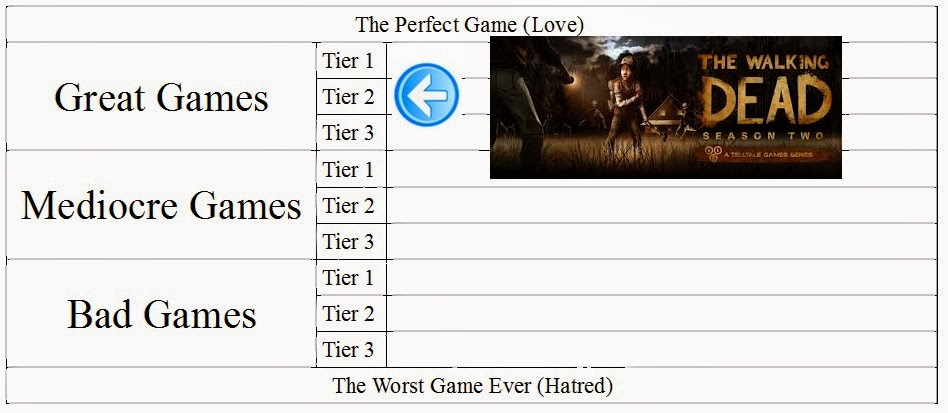
     The bottom line is that season 2 is continuing the excellence in interactive storytelling set forth in season 1. I highly recommend you start playing and keep up with this series, as it is a continuing part of one of the greatest stories in video gaming history. Just keep your fingers crossed that more and more kinks are worked out as the season goes on and that future episodes will be technically flawless as well as continue the dynamite story. If they do, they'll earn perfect scores from me. But for now, episode one is a great game, tier 2.  


Tuesday, January 14, 2014

400 Days Spoiler Post Contains Spoilers!

SPOILER ALERT! DO NOT READ THE BELOW POST IF YOU HAVE NOT FINISHED 400 DAYS, AS IT CONTAINS EXTREME SPOILERS THAT RUIN IT FOR YOU!

Here are my stats real quick:

I killed Stephanie rather than driving off in the RV as Shel.
I stayed in the car and Nate got out, and then I left Nate when we got attacked as Wyatt.
I shot off Justin's foot (the white-collar criminal) as Vince.
I was honest with Leland about braining his wife as Bonnie
Russel's choices didn't make the stat page for some reason even though Wyatt got 2, which is weird. As Russel, I got a ride from that guy, and then told him not to kill the couple and walked off, but he did it anyway.

     Whether or not to kill Stephanie and which prisoner to de-leg where the two hardest choices. It took me like 2 minutes to decide to kill Stephanie, and I'm still not sure I should have. As Vince, I waited until the zombies attacked and killed me the first time before blowing Justin's leg off on the second try. That was a hard one. I started trying to judge the 2 guys' crimes and the fact that Justin admitted his crime and the other claimed innocence. But then I realized how wrong it was to try and do it that way and that any choice you make in that situation is wrong, but everyone dies if you don't do it. It was rough, and I felt horrible for Justin, especially seeing the epilogue pictures in the background of the credits of him being chased down after crawling out of the bus. Those pictures are cool. I even saw the zombie I didn't kill as Russel crawling down the street, and the dead bodies of the old couple that guy shot (is there a way to save them?).
In the end, everyone but Vince, Shel, and her sister went to the settlement. I'm guessing this is based on how you played the different characters. I need to talk to someone else who's played this to see who went for them and what decisions they made...


On to season 2!

400 Days (The Walking Dead DLC) Review

     I've got The Walking Dead Season 2 Episode 1 sitting on my hard-drive, but first I have to play 400 Days.
     400 Days is a DLC chapter for Season 1 of the Walking Dead. See my review of season 1 for details on how it plays, as it's exactly the same. In 400 Days, you play through five short stories in any order you choose. Each takes place at different points within the first 400 days of the zombie outbreak, and each stars a different playable character.
     When I started up the first story, I thought I wasn't going to care enough about the characters to make meaningful choices since each story is pretty short (about 10 to 25 minutes each). A few minutes later, I was totally sucked in to the situation I was dropped into. Each of the 5 mini-chapters are a few scenes in a person's life, and you get dropped right in the middle of it. I hesitated for a good minute or two at the final decision in the first chapter I played, trying to make up my mind what I would do and what the character would do in the situation. Two of the choices you have to make are especially agonizing.
     Much like the main game, 400 days is engaging and excellent. It's very different, since you play new characters in much shorter scenarios, but it does a great job of putting you into the mind of the character.
This review is a repeat of the review of the main game. I don't want to tell you much about the story, other than to say it's excellent. Each mini-chapter is so short, telling you anything about them would ruin the experience. The way each character is introduced and then put into horrible situations and dire choices is done really great. It's also fun to try to get into someone else's head besides Lee's and play a little differently since you aren't playing as Lee. Each time you start up one of the mini-chapters, you don't know what's going to happen. I love that in games (like El Shaddai) and tv shows (like Lost). The feeling that when you start up the next segment anything could happen is born when a show or game's creators have the guts to make things that are different and the skills and wisdom that lets you trust them to do a good job and know that whatever comes up will be great.
     Unfortunately the technical problems remain from the main game (I am so hoping they are absent in season 2!). There's some bad freezing in one scene, a character pops into a scene very noticeably in another, and a plant in the background of one scene moves crazily. It literally sinks into the ground, straight down, and doesn't stop during the scene as if there is a black hole beneath it. Fortunately, there aren't any ugly character models like in the main game; all the new character look great.
     If you're paying attention, there is a lot of overlap and things that make sense depending on the order you play the mini-chapters. You'll see references to things that happened in a chapter you just played, or see why something that wasn't explained is the way it is when you play a chapter that takes place before one you've already done. I'd love to see a whole game done this way, with chapters played out of order and by player choice, with the amount of understanding the player has varying depending on the order they play the scenarios. This could lead to widely varying player experiences and great discussions in an epic sized game that used this mechanic. Imagine finding out that one of the big reveals at the end of your game was the first thing someone else learned about in their's. Even in this short game seeing little details explained in this manner was very cool, so seeing it on a bigger scale with important plot points would be really great if it was handled correctly. Telltale should try it, although obviously it wouldn't work with an episodic game (unless you got a random episode each time you bought one or something weird like that. But then all the episodes would need to be done before they sold any, which would mean the wait time would be artificial. There's got to be a way to do it though. Try it Telltale!).
     I don't get why there are 2 missable trophies, especially since I don't believe in going back and re-playing these games. What's done is done, part of the experience is that you can't go back and do things differently, for me anyway. So I don't get why there are some trophies you get for doing some random stuff that is part of your decision making. It kind of punishes you for doing what you wanted to do, which is bad for a game like this. So I won't be going back to get the one I missed, despite how much I love trophies.
     To summarize, the stories told here are great little snapshots in the lives of people trying to survive the zombie outbreak. Much like the main game, I made decisions and said things, and then second-guessed myself and wondered if I had done the right thing. I made mistakes, and had my conscience genuinely engaged. Once again, the technical problems are pretty bad, but can't drag down the experience. 400 days is short but satisfying. It is a great game, tier 2.


Friday, January 10, 2014

Grubbins On Ice (Costume Quest DLC) Review

     I was planning on downloading Grubbins On Ice and playing it during a snowstorm since it is set partially in a snowy environment. The snowstorm beat me to it though, as it wasn't on the hard drive before the storm hit! Luckily I was able to get out a day or so later and grab it, so I still got to play it with snow on the ground. Things that take place in snow are really fun to experience if there is actually snow outside. I read Mouseguard Winter 1152 with snow on the ground and watched The Thing under snowy circumstances, and they were both the more enjoyable for it. Appropriately, on the day I'm publishing this, the roads are covered in ice. I even got stuck in a valley in the road filled with ice. Makes me wish there was slippery ice in the game...
     Grubbins On Ice is a DLC pack for Costume Quest. It is an additional area with its own story that is basically a sequel to the game. It is 1/3 the length of the original game. It took me about 2.5 hours to beat. Please read my review ofCostume Quest for more detail on how it plays, as it's basically identical.
    It's got more of everything. 3 new costumes, 8 new battle stamps, and 18 new Creepy Treats cards (once again, a highlight for me, they are so cool!). The new area is the world of the monsters. There is a new race of monsters with several classes to fight. Lucy gets kidnapped and you have to save her. You play as Wren, Reynold, and Everett, who hook up with an underground monster rebellion (complete with Che Guevara style beards and berets).
   Once again, the writing is really witty and well done, with great nods and references and generally funny stuff. Once again, though, the battle system and basic gameplay is slightly boring after awhile. Because the mechanics started to get boring toward the end of the main game, I really think there should have been a few twists thrown into this DLC's main gameplay of trick-or-treating and fighting battles. I especially felt it when I had to fight several identical battles in a row. Getting experience isn't an issue, so I was thinking, “Does the game think the outcome of this battle will be different this time?”
   In general, the graphics seem to have a little more polish than the main game, although I ran into a few frame-rate problems. The river and water-fall of green goo that runs through the whole area is especially beautiful and impressive, as are the handful of cutscenes that seem to have a little more camera action than we got in the main game.
     Despite the lack of innovation, seeing the new costumes, new areas, new attacks, and new collectibles, as well as enjoying some more witty dialogue and visual gags, all make the game fun to run through. It just would have been a lot better with a few twists on the gameplay to make that more interesting as well. I'm going to give say it's a mediocre game, tier 1. The writing and visual design are of course somewhere up in the great game tiers, but the gameplay isn't.


Saturday, January 4, 2014

Retro/Grade Review

     After beating Retro/Grade once on one of its medium difficulties, I was sick of it, and sat down to write a nasty review giving it a low score. Before I began writing, I decided to play 1 more level. Many days later, I am here writing my positive review. Retro/Grade is different, and therefore takes some getting used to, but once you fully understand it, it's pretty ingenious.
     Retro/Grade is 80% rhythm game and 20% shmup. The story begins as Rick Rocket takes out the last boss of his final mission. You pilot his space ship during the last section of the final fight. Once he defeats this enemy, the flow of time starts to reverse. In order to prevent damage to the space-time continuum, Rick must undo all of his actions and ensure that his enemies actions are undone in exactly reverse order. So he must catch his shots back in his guns as they fly back at him from the right side of the screen and dodge enemy fire from the left side of the screen as it flies back into the guns of his enemies. All of this catching and dodging is timed perfectly to the game's music.
     Your shots fly back at you in 2-5 rows, depending on the difficulty you choose. In order to catch a shot, you must move to the row it is in and press cross when it reaches your ship. At the same time, you must move out of the path of enemy bullets as they come at you from the left side of the screen and then progress back into the enemy ships' guns. You must be in a different row when these shots reach your ship. If you fail to catch a shot back in your gun or if an enemy bullet hits you, then events have been changed and the space-time continuum is damaged. Space-time has a health bar in the upper left side of your screen, and if it is depleted, then space-time has been altered too much and collapses, causing a game over.
     Enemy fire can contain power-downs, such as score penalties and temporarily disabling your retro/fuel (explained in a minute, don't worry!). There are a few twists on this basic formula as well, such as bosses with melee attacks and gravity bombs, and rapid-fire missiles and sustained lasers you need to catch with your ship. The game also puts its basic mechanics through their paces. Harder levels are a dense maze of enemy fire and a complex pattern of friendly fire coming at you from two directions at once. Some patterns also play with your expectations, sending waves of enemy fire at you that make you move in bizarre patterns that don't make sense if you were just trying to catch all of your fire. When moments like this match up with the music perfectly, the results are magical.
     Some of your shots contain power-ups, such as a shield that protects space-time from damage, multiplier boosters (which ups your points multiplier by a few levels (normally your multiplier builds up slowly as you progress without making a mistake)), overthrusters (this is a power-up that temporarily doubles your multiplier. You activate it by pressing R1), health for the space-time continuum, score bonuses (your score starts high and goes down since time is reversed!) or retro/fuel refills. Retro/fuel is the mechanic that really sets this game apart from a lot of other rhythm games in my opinion. You have a retro/fuel meter that you can drain at any time by holding down circle. As long as it is held down, time reverses. Well actually, time is already reversed, so time moves forward. So if you make a mistake or are about to die, you can use retro/fuel to rewind the level a bit and try again. If you get a game over and still have retro/fuel left, you can rewind out of the game over screen and back into the level to go at it again. This mechanic really lets you wrestle with the game's levels in a way that most rhythm games don't. Even if you are on a level that is really hard for you, if you use your retro/fuel intelligently, you might have a shot at beating it. You can use it to go back and get power-ups you missed, for example, allowing you to continually heal up after your mistakes. A lot of rhythm games seem to demand perfection and that's it, but retro/fuel allows you to make mistakes but then wrestle your way through a level.
     Another way that this game differentiates itself from other rhythm games is in the music department. You'll remember that I dinged Patapon for not have enough good music. Retro/Grade does not have this problem. It's electronic music soundtrack is one of the best in gaming. If your into that type of music, it's very much worth listening to even if you're not going to play the game (the soundtrack is available on PSN). It's the kind of high quality electronic music I associate with groups like Daft Punk and Justice: so good it makes other electronic music sound lazy. Rhythm games often suck you in and make you feel like you are part of the music. Retro/Grade does that too, but it's music is of such high quality that the experience is even greater than many other games. These songs will be stuck in your head forever, and that's a great thing. Picking a favorite is impossible. When I tried to think of which is my favorite, I'd play through a level and say, “That's the best song.” Then I'd do another and say, “That's actually just as good as the last.” Then I did that again. And again. In all about five of the ten songs are all equally in first place in my mind, and the other five are really great too. Walking around at work, I sometimes imagine the whole place lit up in the neon aesthetic of Retro/Grade, each cubicle-dweller bobbing their head to the beat.
     After you beat the ten level campaign, which doesn't take that long, there are other difficulties to try (six in total). There is also the extensive challenge mode, which is a large map of levels you can fly through. There are over 100 levels on this map. Each throws you into a level at a certain difficulty and with some alternate rules. These can range from reversing the level so that it appears backward to making all enemy shots have power-downs to increasing or decreasing the speed (the music sounds amazing slowed down or sped up!) to making you beat the level without any mistakes or hitting every shot dead on (as there are a few degrees of accuracy for hitting each note). This sounds like it might get boring as there are only ten songs, but amazingly the little variations the special rules add keep things fresh throughout the whole map. Beating certain tracks of these levels will unlock secret stuff, such as cheats (big head mode and level modifications), a music player, concept art (including some cool progressions from art to final models), and most interestingly to me, different player ships. There's quite a few ships to unlock, including a bunch of cool characters from other indy games such as Octodad and Super Meat Boy. Much like Bit.Trip Runner 2, these other ships play the same but are new characters with new animations; they are really to cool to unlock and experience. Completing challenge mode is a lengthy process, and the final stages are super-hard, but doable (and fun!).
     Trying to get the trophies for high ranks on campaign mode are the game's ultimate challenges. At their worst, they require you to do perfect runs of the hardest difficulty. After a few days of trying, I was only very slowly making my way toward this goal. So I decided to go out in a blaze of fun and got the trophy for getting the 2nd best ranks on the hardest difficulty. If you are super-hardcore though, the perfect run challenge awaits you.
     Retro/Grade can be controlled with a traditional controller or a guitar controller. Months after first publishing this review, my sister-in-law bought a guitar controller, so I borrowed it to try it out with this game. When using a guitar, you press the fret buttons to jump to the lane you want to be in and then strum to un-fire your shots. The whammy bar controls your retro fuel, and overboost seems to go off by itself whenever you get it. The guitar was fun to mess around with for a few levels, and it's different enough from Guitar Hero or Rock Band (especially dodging enemy fire), but since I learned how to play the hardest levels on a controller, I'm not interested in learning all over again with the guitar. If you're looking for another guitar game to play though, going through the game from the beginning and learning how to un-fire and dodge shots would probably be a lot of fun. Although I'm not sure how you would beat certain score challenges with overboost activating automatically. Unless my guitar is busted or I was holding it at too steep an angle, I don't understand why you don't activate overboost by tilting the guitar up...
     Some of the harder stages at first seem like they aren't possible to do with a conventional controller and that they were made for guitar. But once I got a little more experience with the game, I came back to these levels and was able to do them with a controller. I've never mashed on a controller more than I have on this game. The hardest levels are physically exhausting to play on a controller. I mashed on it so hard, I could feel the plastic creaking under the stress. At one point, I actually had to quit in the middle of a level. My forearms were burning and my hands refused to move. It reminded me of the way I mash on the controller to play hard levels in Wipeout HD, only way worse. This is, of course, really awesome.
     I wanted to give a shout-out to the vibration in this game. I am so used to vibration in games that I often don't notice it. You would expect the vibration to just be a steady beat for a rhythm game, but this game's vibration sends subtle signals to you that actually match the notes rather than just the tempo. It's doesn't vibrate on every note, just a subtle buzz here or there that matches what you are hearing. It's really the first innovative use of vibration I've seen in many years, so kudos for the polish on that.
     Kudos to the polish on everything in the game, actually. If you've read anything about the game's developer, Matt Gilgenbach (check out this Polygon article), you know that he worked really, really, really hard on it, and it shows. With a few little exceptions, it runs like a dream. There are no loading times, and the graphics are stunning. The attention to detail in the graphics and interface are really remarkable. Much like Wipeout HD, the backgrounds are crazy detailed and gorgeous looking even though you will never have time to look at them. Check out the way the lights on the ship and stuff in the background and shots all flash to the tattoo of the level. Check out the shadows the boss casts in level 4 or the stunning sunrise in level 8 (which is actually a sunset in reverse!), or the textures on the big-head mode versions of the ship pilots. The story is minimal, but the level descriptions and song names are all clever/hilarious. I know Mr. Gilgenbach says he made some mistakes with his priorities and work ethic (basically he felt he neglected his wife a bit during development), but his hard work shows. I wish him all the best in balancing development of his new game Neverending Nightmares and his family life.

     Once you get used to Retro/Grade's high concept and slight spin on traditional rhythm gaming, it becomes an addictive and wonderful experience. I don't know how the idea for this game was thought up, but it works brilliantly. The music is the real clincher. The seriously excellent soundtrack would make even a bad game worth playing. Fortunately the mechanics and feel of the game, and especially the retro/fuel system, are really good too. I kind of don't like rhythm games too much because they just tell you what to do and you have to do it exactly, but I loved Retro/Grade. It's a great game, tier 2.